Tracing recovery timelines for players juggling ATP schedules with national team duties in football-dominant regions
Riley Günther · Sep 14, 2026

Tracing recovery timelines for players juggling ATP schedules with national team duties in football-dominant regions
ATP calendars place significant demands on professional tennis players who also represent their countries in Davis Cup ties, particularly those based in regions where football commands the majority of national sports infrastructure and media attention. Scheduling conflicts arise when back-to-back tournaments overlap with national team windows, forcing athletes to compress travel, match play, and physical restoration into tight sequences that can span multiple continents within a single month.
Scheduling pressures in football-dominant markets
Players from countries such as Brazil, Argentina, and Colombia often navigate ATP 500 and 1000 events alongside Davis Cup commitments during the same calendar blocks, because national football federations receive priority access to training facilities and medical staff. Data compiled by the International Tennis Federation shows that South American squads face longer average travel distances for away ties than European counterparts, extending recovery windows by 48 to 72 hours beyond standard rest protocols. Observers note that these extended journeys compound fatigue when players must return immediately to ATP hard-court or clay-court swings.
September 2026 features a planned Davis Cup group stage round that coincides with the final weeks of the Asian swing on the ATP calendar, creating a documented pinch point for athletes who qualify for both events. Tournament directors in Tokyo and Beijing have adjusted draw sizes in prior years to accommodate national team releases, yet recovery timelines remain compressed because most players lack dedicated on-site physiotherapy support once they switch from ATP to Davis Cup environments.
Documented recovery protocols and timelines
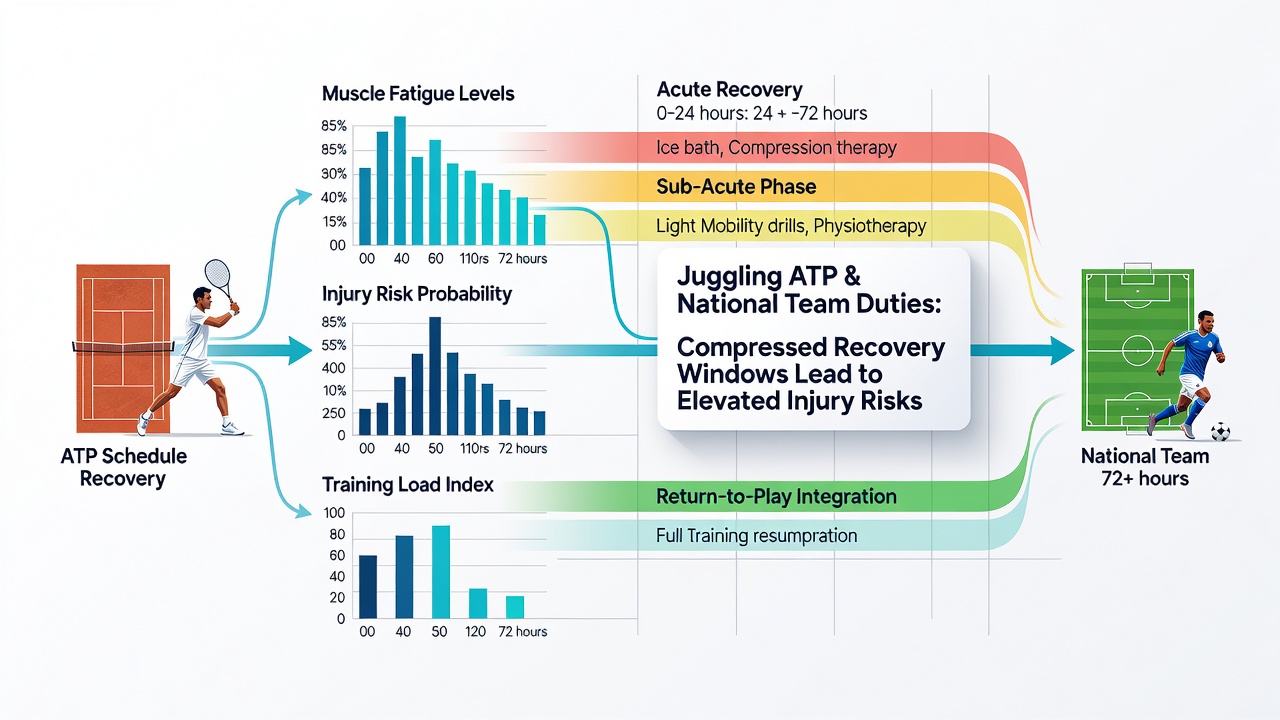
Research conducted at the University of Calgary's Sport Injury Prevention Research Centre tracks return-to-play markers for athletes crossing between individual and team formats. Their findings indicate that full neuromuscular recovery after a best-of-five Davis Cup match requires between five and seven days when combined with intercontinental flights, whereas isolated ATP matches allow most competitors to resume training within 72 hours. Protocols emphasize sleep extension, cryotherapy cycles, and targeted lower-limb loading that can be executed in hotel gyms when national federation resources are allocated elsewhere.
One Brazilian player who balanced an ATP 250 title run in Santiago with a subsequent Davis Cup tie in Montevideo required an additional four days of active recovery before re-entering the Rio Open draw, according to publicly released training logs. Similar patterns appear in Argentine squads where football club medical departments occasionally lend staff during off-seasons, yet availability drops sharply once domestic leagues resume.
Regional support disparities and adaptation strategies
National tennis federations in football-centric nations frequently operate with smaller budgets for sports science personnel, leading many athletes to self-fund recovery specialists who travel with them between ATP and Davis Cup obligations. Reports from the Australian Institute of Sport highlight how visiting players from Latin America adopt portable monitoring devices to maintain consistent load management data across both competition types, because host federations may not supply equivalent tracking technology. This self-directed approach allows objective measurement of heart-rate variability and muscle soreness markers that guide decisions on whether an extra rest day is feasible before the next ATP commitment.
European governing bodies such as the French National Institute of Sport have published comparative analyses showing that athletes with hybrid schedules experience elevated soft-tissue injury rates when recovery periods fall below five days between surfaces. In response, several South American players now insert mandatory 36-hour blocks of low-intensity work immediately after Davis Cup ties, even when ATP ranking points are at stake.
Case examples from current cycles
Take the documented path of a Colombian competitor who contested three ATP events across Europe in late summer before flying directly to a home Davis Cup tie against a North American opponent. Performance analytics released by the ATP revealed that his first-serve percentage dropped 7 percent in the opening round of the subsequent tournament, correlating with reduced recovery time between the two obligations. Federation records indicate the player then extended his off-court preparation by two full days before the next event, restoring baseline metrics within the standard window.
Similar adjustments appear in Mexican players who split time between ATP 500 events in Acapulco and regional Davis Cup qualifiers, where altitude differences further extend adaptation periods. Monitoring data collected during the 2025 season demonstrated that structured altitude acclimatization combined with sleep hygiene protocols shortened the return-to-baseline window by approximately 24 hours compared with previous cycles.
Conclusion
Recovery timelines for athletes managing ATP schedules alongside national team duties in football-dominant regions follow consistent patterns shaped by travel distance, surface transitions, and available support infrastructure. Studies from institutions across North America and Europe continue to supply benchmarks that players and federations apply when constructing annual calendars. These objective measurements allow competitors to allocate precise rest intervals that preserve both ranking points and national team availability without extending beyond documented physiological limits.